
Manufacturing notes
What every brand should specify before ordering a PVD finish
Most guidance on PVD is written for people buying a watch. This is written for the people specifying one — and for the sourcing decisions that determine whether hardware still looks intentional in year five.

There is a particular kind of complaint that reaches a watch brand about eighteen months after a collection ships. The movement is fine. The crystal is fine. But the gold on the clasp has worn through to bare steel, and the watch now looks older than it is.
The instinct is to blame the metal. It is almost never the metal. It is how the colour was put onto it — and, more often than brands realise, it is what was left unsaid on the purchase order.
Coating is one of the few components in a watch that is routinely bought without a specification. A brand will define case tolerances to a tenth of a millimetre and then order a finish by naming a colour. The result is a decision worth several years of product reputation being made by whoever happens to be running the coating line that week.
This is a working guide to what should actually appear on that order.
Why plating fails and coating does not
Electroplating deposits a layer of colour onto the surface of a component through an electrochemical bath. It is fast, inexpensive, and entirely adequate in the box. Its weakness is structural: the colour sits on top of the substrate rather than within it, held by a comparatively weak bond.
Daily wear then does what daily wear does. At the clasp, the underside of the buckle, and the lug ends — the three points of highest contact — the layer abrades. Once it is through, there is no repair. The component is replaced or the watch carries the flaw.
Physical Vapour Deposition takes a different route. Inside a vacuum chamber, a solid target material is vaporised and the resulting particles are deposited onto the component, bonding at a molecular level rather than resting on the surface. The coating becomes part of the substrate’s outer structure.
The practical difference is hardness and adhesion. A PVD layer is substantially harder than the stainless steel beneath it, markedly more resistant to scratching and corrosion, and it holds colour through years of contact with skin, perspiration and cuff friction.
A coating that costs more to apply and less to live with is not an upgrade. It is a different category of decision.

Finishes and where they belong
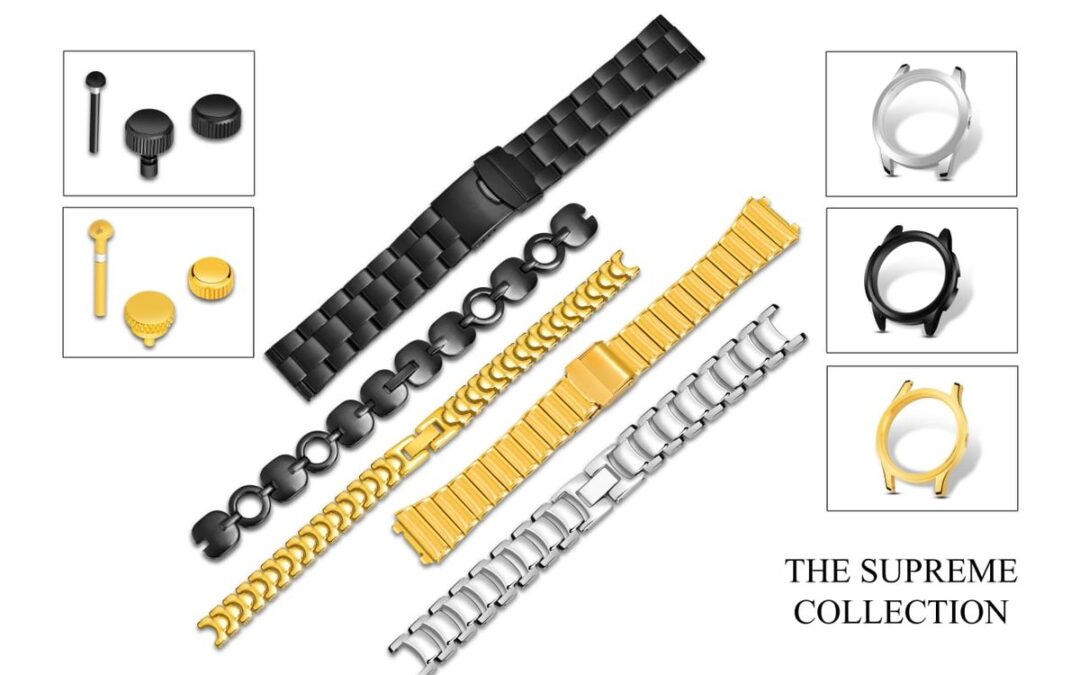
The finishes we apply through Supreme PVD Technologies, and the reasoning behind each.
| Finish | Best suited to | Watch for |
|---|---|---|
| Gold | Dress and classic collections where warmth and brightness carry the product | Tone drifts between batches unless a colour reference is fixed at approval |
| IP Rose Gold | Contemporary and fashion-led ranges; softer and warmer than yellow gold | Reads differently on polished than on brushed surfaces — approve on the actual finish |
| Black | Sport, field and contemporary ranges; the hardest of the finishes | Every substrate blemish is reproduced, not hidden — preparation is decisive |
| IP Gun | Understated sport and tool ranges wanting depth without full black | Sits between black and steel; needs a physical master or it drifts either way |
| IPS Steel | Ranges needing the appearance of steel with materially better wear resistance | Brushed and polished areas must be defined before coating, not after |
The substrate decides the outcome
This is the part most often missed, and it is the one that causes the majority of rejected batches.
PVD does not conceal. A coating of one to three microns is thinner than a fingerprint; it follows the surface it is applied to with complete fidelity. A polishing mark left on the case flank before coating will still be there afterwards, now sealed beneath a hard layer and impossible to correct without stripping and starting again.
Which means the finish quality of a PVD component is settled before it enters the chamber. Cleaning, degreasing and surface preparation are not preliminaries to the coating process. They are most of it.
When a brand sends components for coating, the useful question to ask the supplier is not what colour they can achieve. It is what surface finish they require on arrival.

Thickness, and why more is not better
There is a common assumption that a thicker coating lasts longer. Past a point, the opposite becomes true.
For watch components, coatings generally sit in the low single-digit micron range. Within that band the layer is hard, well adhered, and dimensionally irrelevant to how parts fit together. Push significantly beyond it and internal stress in the coating increases, adhesion becomes less reliable, and the layer becomes more prone to chipping at edges rather than less.
Thickness should be specified as a range with a tolerance, in the same way any other dimension on the drawing would be. A component that needs to mate with a spring bar, a pusher seat or a bracelet end link has a tolerance stack that a coating sits inside.
What belongs on the order
Most coating disputes are not disagreements about quality. They are disagreements about what was agreed, resolved after the fact by whoever has the better documentation.
Before you release the purchase order
Seven lines that prevent almost every avoidable dispute.
- Colour reference — an approved physical master, retained by both parties.
- Coating thickness — a range with tolerance, not a single figure.
- Substrate finish on arrival — brushed, polished, or mixed, with areas defined.
- Masking — any surface that must remain uncoated, marked on the drawing.
- Adhesion criteria — the test method and the pass condition.
- Corrosion requirement — the standard and the duration expected.
- Retained samples — one approved piece held by each side for the production life.
None of this is unusual to ask for. It is unusual to ask for it before the first order rather than after the first problem.
Where this fits
Coating is rarely a standalone decision. The buckle on a leather strap, the end links on a bracelet and the case of the watch it all attaches to should read as one product — and they frequently do not, because they are finished in three different places to three interpretations of the same colour.
We manufacture leather straps at our facility in Peenya, Bengaluru, produce stainless steel bands through Steelex Horological, and apply PVD finishes in gold, rose gold, black, gun and IPS steel through Supreme PVD Technologies. Components across a collection can be coated in the same facility, against the same approved reference, in the same production window.
Which is not a claim about craft. It is a claim about variance — and variance is what shows up on the wrist three years later.
Specifying a finish for an upcoming collection
If you are preparing a specification and would like the coating section reviewed before it goes out, send it across. We will tell you what is missing, whether or not the work comes to us.
SKD Leather India Pvt. Ltd. has manufactured watch straps and leather goods in Bengaluru since 2010 and is ISO 9001:2015 certified.
 English
 German
Recent Comments