
Manufacturing notes
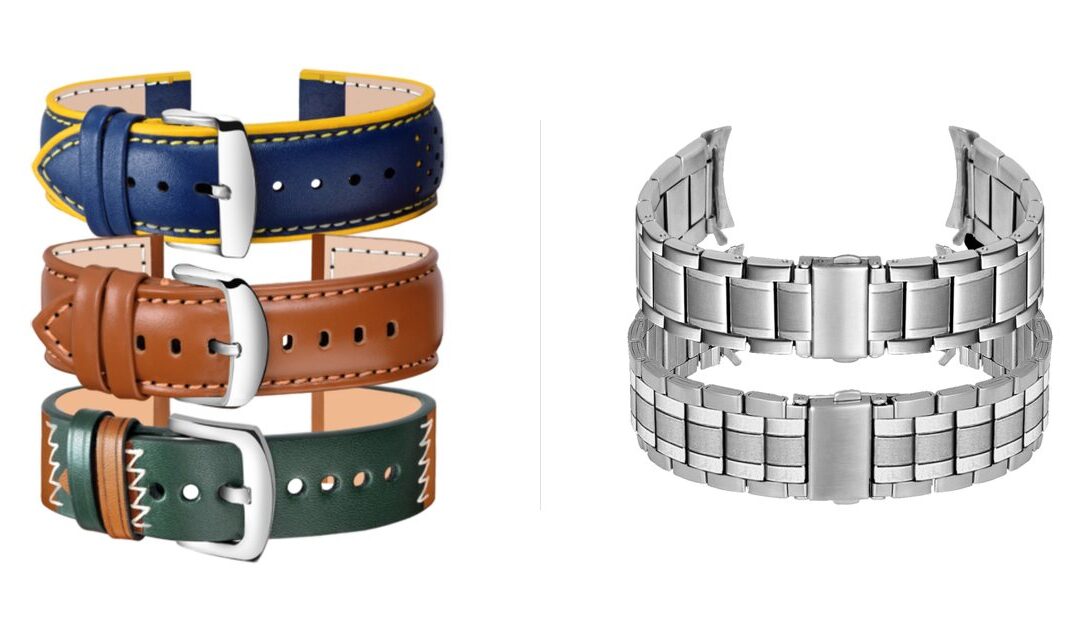
Leather, steel, or both
Building a strap range is not a question of which material is better. It is a question of what a collection needs to cover — and how many suppliers it should take to cover it.

A brand launches on leather. It suits the product, the margins work, and the photography is warm. Eighteen months later the requests start arriving — a retailer wants a steel option, a distributor asks what the bracelet version would cost, and a customer emails to ask whether one exists.
At that point the brand faces a decision it did not plan for, usually under time pressure, and usually by finding a second supplier quickly.
That sequence is common enough to be worth getting ahead of. What follows is how the two materials actually differ in use, and what changes when a collection carries both.
What leather does
Leather is the warmer, more personal choice, and it is the one that changes over time. A genuine leather strap develops a patina, softens to the wearer, and after a year looks specific to the person wearing it rather than identical to every other unit that shipped.
That is the argument for it, and it is a strong one. It is also comfortable in a way steel is not — lighter, quieter, and better against skin in heat.
The trade-offs are real. Leather has a service life. It responds to water, perspiration and sustained heat, and a customer who swims or trains in a leather strap will replace it. For most brands this is not a weakness so much as a fact to design around — and, handled well, a reason for a customer to return.
What steel does
A stainless steel bracelet is the durable answer. It survives water, heat and daily impact, it does not need replacing on a cycle, and it carries a weight on the wrist that a significant part of the market reads as quality.
It is also the finish-critical choice. A bracelet is dozens of links, each with a surface that has to match its neighbours and the case it attaches to. Brushed and polished areas have to be defined and executed consistently across every link, and an end link that does not sit flush against the case is visible to anyone who looks.
Steel is less forgiving to manufacture well, which is precisely why the difference between a good bracelet and an average one is so obvious in the hand.

Choosing between them
Neither material is better. They answer different questions about who the watch is for.
| Genuine leather | Stainless steel | |
|---|---|---|
| Character | Ages and personalises with wear | Stays consistent over its life |
| Durability | Finite service life; a replacement cycle | Effectively indefinite with basic care |
| Water and heat | Degrades with sustained exposure | Unaffected |
| On the wrist | Light, warm, quiet | Weighted; reads as substantial |
| Suits | Dress, heritage, field and everyday ranges | Sport, diver, tool and premium daily wear |
| Aftermarket | Recurring revenue from replacement | Sold once, worn for years |
Why most ranges end up carrying both
The same watch on leather and on a bracelet is, commercially, two products. It reaches two buyers, photographs in two registers, and gives a retailer a reason to stock depth rather than a single reference.
It also gives an existing customer somewhere to spend again. A bracelet offered as an accessory to a leather-first watch is one of the few upsells in the category that requires no new product development.
The question, then, is rarely which material. It is how to carry both without the range falling apart visually.
A collection is judged on whether its parts look like they were made together — not on whether each part is good.
The problem with sourcing them separately
Leather and steel are different crafts, and the usual response is to use different suppliers for each. That works until the two products sit side by side.
The buckle on the leather strap is polished to one interpretation of polished. The bracelet clasp is polished to another. If either is coated, the gold or black on one is a shade away from the gold or black on the other, because they were finished in different facilities against different references. Each supplier delivered exactly what was asked. The collection still looks assembled rather than designed.
The operational cost compounds the visual one: two lead times to coordinate, two quality standards to manage, and no single party accountable when a launch date depends on both arriving together.
Carrying both from one place
We manufacture genuine leather straps at our facility in Peenya, Bengaluru. Stainless steel bands are produced through Steelex Horological. PVD finishing in gold, IPS steel and black is applied through Supreme PVD Technologies.
The practical consequence is that the buckle on a leather strap and the clasp on the matching bracelet can be finished in the same facility, against the same approved reference, within the same production window — so a collection reads as one product family rather than parts bought separately.
One brief. One standard. One conversation about where the order is.
For a brand deciding whether to add a second material, that is usually the part that decides it — not the material question, which answers itself once you know who the watch is for.
Adding a second material to your range
If you are weighing a bracelet alongside an existing leather line, or building a collection that needs both from the start, send us the watch and we will come back with options and an honest view on what each one costs you.
SKD Leather India Pvt. Ltd. has manufactured watch straps and leather goods in Bengaluru since 2010 and is ISO 9001:2015 certified.
 German
 English